Grades 5โ€“8 ยท Earth Science

Weather & Climate: The Engine in the Sky

One star, one tilted sphere, and an ocean of invisible gas create every breeze, blizzard, and sunny afternoon on Earth.

Who (subject) Does (verb) Vocabulary

The Invisible Engine

Every time you feel wind hit your face or watch a thunderstorm darken the sky, you are standing inside a massive, invisible engine. The Earth is wrapped in a blanket of gases called the atmosphereThe layer of gases โ€” mostly nitrogen and oxygen โ€” that surrounds the Earth and makes weather possible, and everything that happens in it โ€” every breeze, every blizzard, every sunny afternoon, and even the reason summers are hot and winters are cold โ€” is powered by a single source: the Sun.

But the Sun does not heat the Earth evenly, and that one fact changes everything. Because the Earth is a sphere, the equatorThe imaginary line around the middle of the Earth, equally distant from the North and South Poles faces the Sun head-on and absorbs intense, direct rays. The poles, however, sit at a steep angle to the Sun. Sunlight there arrives weak and spread thin, like a flashlight beam aimed at the ground from far away versus directly overhead. This uneven heating is the root cause of all weatherThe short-term, hour-by-hour conditions of the atmosphere โ€” temperature, wind, rain, and clouds โ€” the day-to-day conditions like wind, rain, and temperature โ€” and all climateThe long-term pattern of weather in a place over many years โ€” the reason some places are always hot and some always cold โ€” the long-term patterns like why some places are tropical and others are frozen year-round.

North Pole South Pole Equator DIRECT RAYS weak, angled weak, angled

The equator gets direct, intense sunlight. The poles get weak, angled rays โ€” and that difference drives all weather.

Key Idea

The Sun heats the Earth unevenly because the Earth is a sphere. The equator gets strong, direct sunlight. The poles get weak, spread-out light. This imbalance is the root cause of all weather and climate.

Hot Air Rises, Cold Air Sinks

Picture what happens at the equator. The Sun beats down on the ground, and the air just above the surface heats up. As that air warms, its moleculesThe tiny particles that make up air โ€” too small to see, but they move faster when heated and slower when cooled speed up and spread apart. The air becomes lighter and begins to float upward, like an invisible hot-air balloon rising off the ground. As it lifts away, it leaves behind a gap โ€” a zone of thin, light air called low pressureAn area where air has risen away, leaving fewer air molecules packed together โ€” this "gap" pulls wind toward it.

Now picture the poles. Without strong sunlight, the air there grows cold. Cold air molecules slow down, pack tightly together, and become heavy. This dense air sinks toward the ground and piles up, creating a zone of thick, heavy air called high pressureAn area where cold, heavy air has piled up โ€” this dense air pushes outward toward low-pressure zones.

WARM AIR RISES EQUATOR โ€” LOW PRESSURE COLD AIR SINKS POLES โ€” HIGH PRESSURE molecules spread apart molecules packed tight

At the equator, warm air rises and leaves behind low pressure. At the poles, cold air sinks and piles up as high pressure.

Think about it: Warm air is like a hot-air balloon โ€” it floats upward because heated molecules spread apart and become lighter. Cold air is the opposite โ€” the molecules huddle together and become heavy.

The atmosphere is one connected ocean of air. Heavy cold air from the poles pushes toward the equator, warm air from the equator flows toward the poles, and everywhere in between, the air mixes into zones of different temperatures โ€” some hot, some cool, some cold โ€” depending on how far they are from the equator.

The Birth of Wind

Here is where wind is born. Anywhere the Sun heats one spot more than another โ€” a parking lot next to a park, land next to ocean, a sunny valley next to a shaded mountain โ€” the warmer air rises and leaves behind a gap of low pressure. Cooler, heavier air nearby immediately rushes in to fill that gap. That rush is wind.

Imagine pulling the plug in a full bathtub โ€” water immediately floods toward the drain. Wind works the same way: it is the atmosphere flooding from where air is packed tight to where air has lifted away.

Red molecules spread apart and rise (low pressure). Blue molecules pack together and sink (high pressure). The rush between them is wind.

This happens everywhere, all the time, at every scale. A sea breeze at the beach is cool ocean air rushing toward warm land. A cold front is heavy, chilly air pushing underneath lighter warm air. Even a campfire creates a tiny wind โ€” hot air rises above the flames and cooler air rushes in from the sides.

This same principle also works at the scale of the whole planet. Because the equator is always warmer and the poles are always colder, there is a constant, global flow of air that creates the steady background winds that move weather systems around the Earth.

Key Idea

Wind is not random. It is air flooding from high-pressure zones (where cool air piles up) to low-pressure zones (where warm air has risen away). Any temperature difference, anywhere, can create wind.

Add Water: Clouds and Storms

Now add water. As wind sweeps across the oceans, it picks up moisture โ€” water molecules evaporatingWhen liquid water heats up enough to turn into invisible water vapor (gas) and float into the air from the surface into the moving air. When that warm, moist air reaches the equator and rises, it climbs high into the atmosphere where the air is cold.

The moisture cools, condensesWhen water vapor (invisible gas) cools down enough to turn back into tiny liquid droplets you can see โ€” like your breath on a cold day into tiny droplets, and forms clouds. Pack enough droplets together and they fall as rain, snow, or storms. That is daily weather: a cycle of heating, rising, rushing, and condensing, playing out across the globe every single day.

โ‘  EVAPORATES โ‘ก RISES โ‘ข CONDENSES Tiny droplets form clouds โ‘ฃ FALLS as rain! wind carries moisture โ†’ Evaporate โ†’ Rise โ†’ Condense โ†’ Fall โ†’ Repeat!

The daily weather cycle: wind picks up ocean moisture, warm air carries it up, it cools into clouds, and falls as rain.

Go Deeper: Why Does Rising Air Cool Down?

As air rises, the atmosphere above it pushes down on it less. With less pressure squeezing it, the air expands. When gas expands, it loses heat energy โ€” so the temperature drops. This is called adiabatic cooling.

The opposite happens when air sinks: it gets compressed by the weight of air above it, and compression heats it up. That's why valleys and deserts near sinking air masses can be extremely hot and dry.

Why Do We Have Seasons?

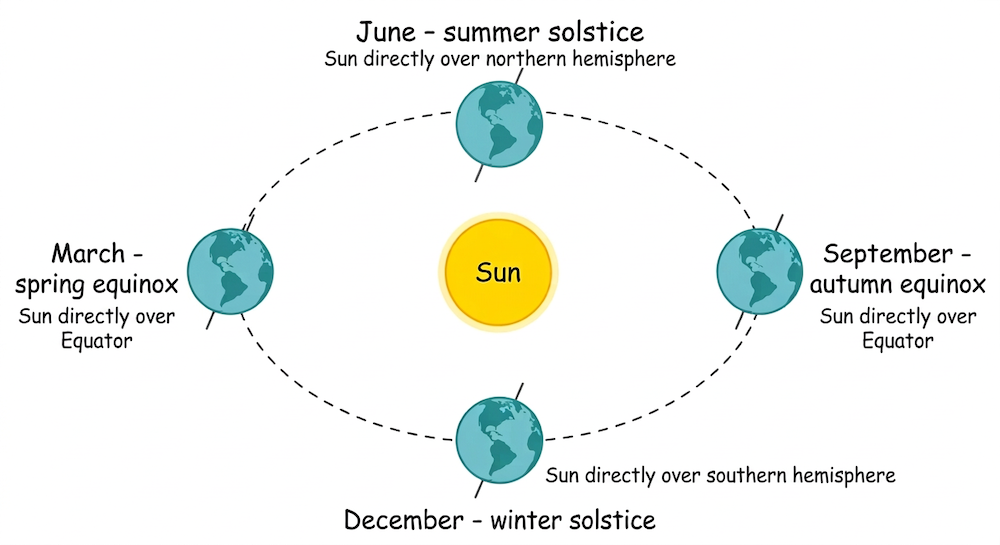
If the Sun heated the Earth the same way all year, every day would feel the same. But the Earth doesn't sit straight up and down โ€” it leans to one side, like a spinning top that's slightly tilted. This tilt is about 23.5 degrees, and it never changes direction as the Earth orbits the Sun.

As the Earth travels around the Sun through the year, the tilt means that sometimes the Northern Hemisphere leans toward the Sun, and sometimes it leans away. When your half of the Earth tilts toward the Sun, sunlight hits more directly and the days are longer โ€” that's summer. When it tilts away, sunlight arrives at a steep angle and the days are shorter โ€” that's winter.

Earth's orbit around the Sun showing four positions: June summer solstice (Sun over Tropic of Cancer), September autumn equinox (Sun over Equator), December winter solstice (Sun over Tropic of Capricorn), and March spring equinox (Sun over Equator). The Earth's tilt stays the same direction at all four positions.

As Earth orbits the Sun, its tilt stays the same โ€” but which hemisphere faces the Sun changes. That's what creates the seasons.

Seasons are the most familiar example of climateThe long-term pattern of weather in a place over many years โ€” the long-term, repeating pattern that stays the same year after year. "Summers in California are warm and dry" is climate. What happens on any specific Tuesday in July โ€” that's weather.

Key Idea

Seasons happen because the Earth is tilted. As it orbits the Sun, the tilt makes one hemisphere lean toward the Sun (summer) while the other leans away (winter). It has nothing to do with distance from the Sun.

Go Deeper: Why Does Tilt Matter So Much?

The tilt changes two things at once. First, it changes the angle of sunlight. Direct rays (hitting straight down) concentrate energy in a small area โ€” like a flashlight pointed straight at the ground. Angled rays spread the same energy over a larger area, so each spot gets less heat.

Second, the tilt changes how many hours of daylight you get. In summer, the Sun is up longer โ€” sometimes 15 or 16 hours. In winter, it might only be up for 8 or 9 hours. More hours of heating plus a more direct angle equals summer. Fewer hours plus a steep angle equals winter.

Here's what surprises most people: the Earth is actually closest to the Sun in January โ€” the middle of winter in the Northern Hemisphere! Distance barely matters. The tilt is what counts.

Weather vs. Climate

While weather is chaotic and changes by the hour, climateThe long-term average of weather conditions in a specific area, calculated over decades of data is the long-term average of those conditions over decades. If weather is the score of a single baseball game, climate is a team's career win-loss record. Scientists calculate climate by tracking decades of daily data and finding the statistical pattern for a specific area.

Weather One week in March 80ยฐ 70ยฐ 60ยฐ 50ยฐ M T W T F S S โ˜€๏ธ ๐ŸŒง๏ธ ๐ŸŒค๏ธ โ›ˆ๏ธ Climate 30-year average by month 80ยฐ 70ยฐ 60ยฐ 50ยฐ J F M A M J J A S O N D ๐Ÿ One game's score ๐Ÿ“Š Career win-loss record

Weather is wild and unpredictable day to day. Climate is the smooth, long-term pattern underneath.

Key Idea

Weather is what's happening right now โ€” chaotic and changing. Climate is the long-term average pattern over decades. Weather is one game; climate is the whole season record.

What Shapes Climate?

Climate is shaped by massive, permanent geographic forces. The most important is latitudeHow far north or south a place is from the equator โ€” measured in degrees. The equator is 0ยฐ, the poles are 90ยฐ โ€” how far north or south a place sits from the equator.

ElevationHow high above sea level a place is โ€” the higher you go, the thinner and colder the air matters too; the higher you climb into the atmosphere, the thinner and colder the air becomes. That is why snow sits on mountaintops even near the equator.

โ„๏ธ COLD & THIN AIR snow even at equator ๐ŸŒฒ COOL & MOIST forests and meadows ๐ŸŒด WARM & DENSE sea-level base Equator (hot) โ† LATITUDE โ†’ Poles (cold)

Two forces that shape climate: latitude (distance from the equator) and elevation (height above sea level).

The Ocean Thermostat

Finally, the oceans act as the Earth's thermostatSomething that keeps temperature stable โ€” the ocean absorbs and releases heat slowly, preventing wild temperature swings. Water holds heat far longer than land does. Enormous underwater currents work like a global conveyor beltA slow, continuous loop of ocean water that carries warm water toward the poles and cold water back toward the equator, carrying warm water from the equator toward the freezing poles while pulling cold water back.

These slow, powerful currents keep the planet's temperature stable enough to support life.

equator WARM โ†’ POLES COLD โ†’ EQUATOR sinks warms The Ocean Conveyor Belt Warm currents carry heat poleward. Cold currents return it. This loop stabilizes Earth's temperature.

Ocean currents work like a global conveyor belt โ€” warm water flows toward the poles, cold water returns to the equator.

Key idea: The ocean is Earth's heat battery. It absorbs warmth slowly, releases it slowly, and its currents distribute that heat around the planet โ€” keeping temperatures stable enough for life.
Go Deeper: The Gulf Stream

The Gulf Stream is one of the most powerful ocean currents on Earth. It carries warm water from the Gulf of Mexico all the way across the Atlantic to northwestern Europe.
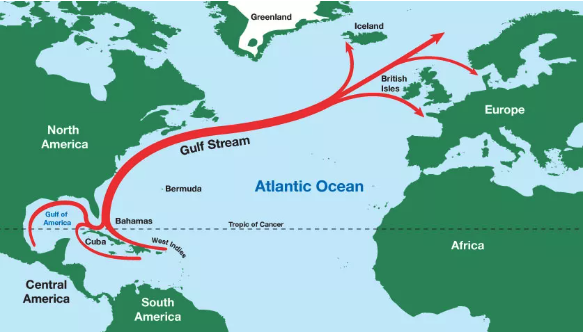
Map showing the Gulf Stream carrying warm water from the Gulf of Mexico across the Atlantic Ocean to the British Isles, Iceland, and Europe

The Gulf Stream carries warm water from the Gulf of Mexico across the Atlantic to Europe. (Credit: NOAA/JPL-Caltech)

That's why London, which sits as far north as parts of Canada, has mild winters instead of freezing ones. Without the Gulf Stream, much of western Europe would be dramatically colder.

Scientists are studying whether climate change could weaken the Gulf Stream โ€” which would paradoxically make some parts of Europe colder even as the planet overall warms.

Putting It All Together

Every time you feel wind on your face, you are feeling the atmosphere rushing to fill a gap. Every raindrop started as ocean water lifted into the sky by heat. Every climate on Earth โ€” from the steaming equator to the frozen poles โ€” exists because one star heats one sphere unevenly, and the planet never stops trying to balance the difference.

Key Idea

All weather is powered by the Sun heating the Earth unevenly. All climate is the long-term pattern of that weather, shaped by latitude, elevation, and the oceans. One engine. One planet. Infinite variety.