The Pantheon

Geometry of the Gods · Rome, 125 AD
Scroll

Temple of All the Gods

If you walk through the streets of Rome today, you will find a 1,900-year-old building called the Pantheon. Built around 125 AD, its name means "Temple of All the Gods." From the outside, it looks like a traditional Roman temple with a rectangular porch and tall columns. But step through the bronze doors and you enter a room designed to be a miniature universe.

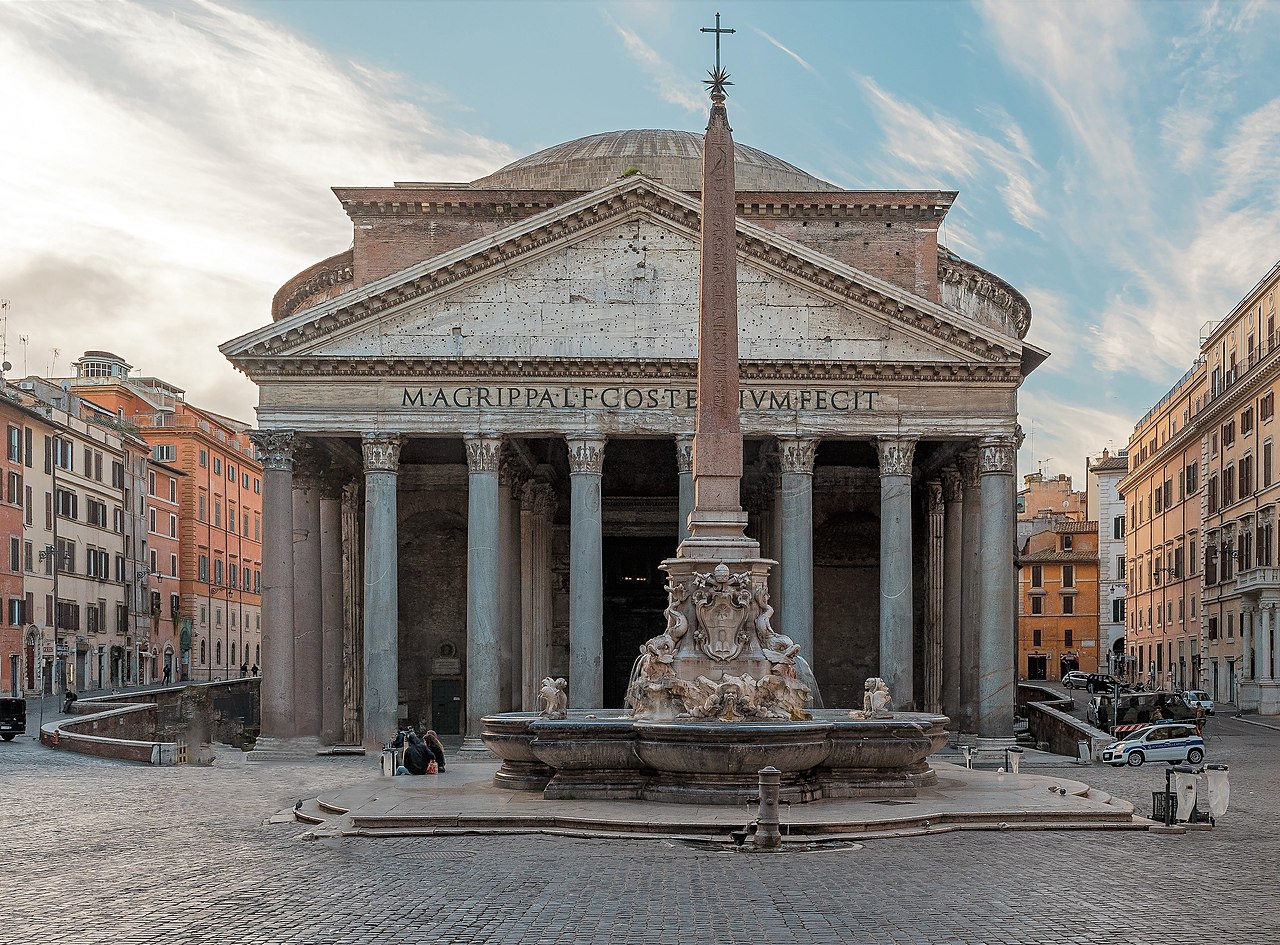
The Pantheon exterior in Rome, showing the portico with its massive Corinthian columns and the inscription M·AGRIPPA·L·F·COS·TERTIVM·FECIT
The Portico · 16 Corinthian columns, each 39 feet tall

The Eye of Heaven

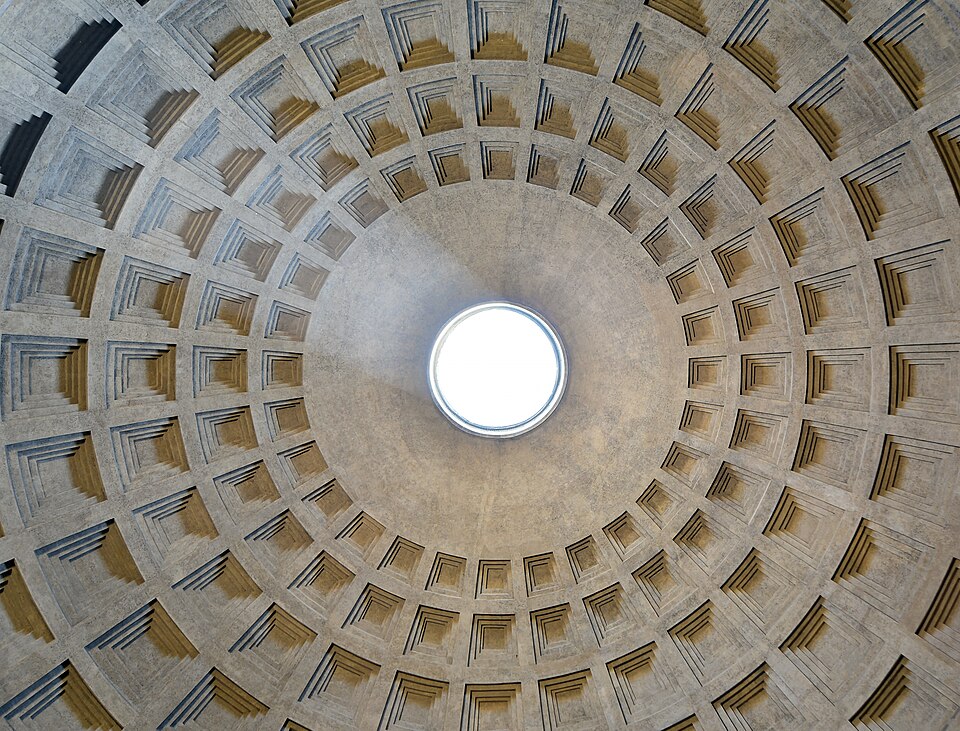
The inside of the Pantheon is a giant cylinder topped by the largest unreinforced concrete dome in the world. But the Romans did not build this dome just to show off their engineering. They built it to frame a single feature: a 30-foot circular hole at the very top of the ceiling, completely open to the sky. The Romans called it the Oculus — Latin for "eye." It is the only source of light in the entire building, and it was the whole point.

Looking up at the coffered dome of the Pantheon, with the circular oculus open to the sky at the center
Interior · The Oculus — a 30-foot opening to the sky

A Sphere Inside a Cylinder

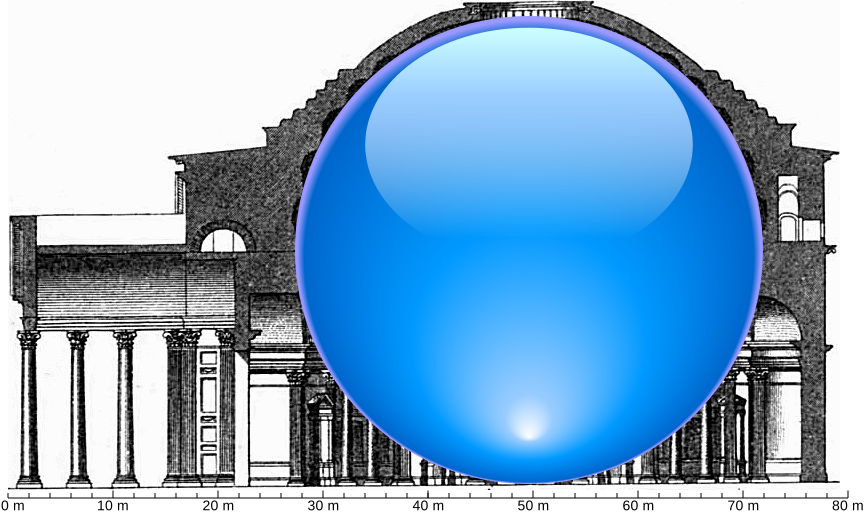
The Oculus was designed as a sacred connection between the human world below and the gods above. The dome surrounding it represented the heavens — a perfect half-sphere arching over the earth. The Romans shaped every proportion of the room to reinforce this idea. The height from the floor to the top of the dome is exactly equal to the width of the room. This means if you inflated a perfectly round bubble inside the Pantheon, it would touch the floor, brush the walls, and kiss the top of the ceiling. The building is a sphere inside a cylinder — the universe captured in geometry.

Cross-section of the Pantheon showing how a perfect 43.3-metre diameter sphere fits inside the dome and walls
Cross-section · A perfect sphere fits exactly inside

A Building-Sized Sundial

But the Oculus also had a hidden function. Because the entrance faces north, direct sunlight can never enter through the door. The only light comes from the hole above. Every day, a beam of sunlight pours through the Oculus and slowly moves across the walls and floor like the hand of a giant clock.

On the summer solstice, the beam hits low on the floor. On the winter solstice, it barely grazes the top of the dome. And on April 21st — the legendary birthday of Rome itself — the midday sun streams through the Oculus and perfectly illuminates the entrance doorway. Historians believe this was designed so that when the Emperor walked through the door on Rome's birthday, he would be bathed in a spotlight of sunlight, as if the gods themselves were shining on him.

DOOR SUMMER SOLSTICE
Interactive · Seasons
Summer Apr 21 Winter

Poured in Mid-Air

To keep this 4,500-ton concrete roof from collapsing, the Romans solved problems that engineers still admire today. They did not lift the dome into place. They poured it in mid-air. First, they built a wooden skeleton inside the building as a temporary mold. Then they poured concrete in horizontal rings, starting from the walls and working upward toward the Oculus. As they went higher, they changed the recipe. At the bottom, they mixed the concrete with heavy, dense rock. But near the top, they switched to pumice — a volcanic rock so light and full of air pockets that it floats on water.

Heavy basalt rock dense, strong Mixed aggregate Lighter stone Pumice floats on water! HEAVY LIGHT Poured in horizontal rings from bottom to top
Engineering · Concrete Gradient

140 Sunken Squares

To shave off even more weight, they carved 140 sunken squares called coffers into the ceiling. And of course, the Oculus itself removes the heaviest concrete from the dome's most critical point — its very top. The engineering that makes the dome possible is the same feature that gives the building its spiritual meaning.

Looking Up · The Coffer Pattern

The Rain Problem

But a hole in the roof creates an obvious problem: rain. The Roman engineers were ready. The marble floor is not actually flat. It curves gently upward in the center like a shallow hill, forcing rainwater to run toward the edges, where it drains through small holes into pipes beneath the floor. Nearly two thousand years later, the system still works.

CENTER — HIGHEST POINT DRAIN DRAIN Still works after nearly 2,000 years
Drainage · Genius in the Floor

Image credits: Exterior photo: Rabax63, Wikimedia Commons, CC BY-SA 4.0. Dome interior: Livioandronico2013, Wikimedia Commons, CC BY-SA 4.0. Cross-section diagram: Cmglee (derivative work), Wikimedia Commons, CC BY-SA 3.0.

The Pantheon proves that geometry is more than shapes on paper. In the right hands, it becomes a language powerful enough to hold up an impossible roof, track the sun, and make an emperor look like a god.